Sunday, July 29, 2012

WOGE 352 Revised Again!

Thanks to several hints from Felix I was finally able to solve WOGE 351. The Dendi Caldera in Ethiopia seems like it would be an interesting place to visit.  I had already wasted a modest amount of time searching areas around the Mediterranean before I caught on to the second picture.  A Google image search for "round thatched huts" turned up a number of pictures from Ethiopia mixed with those from various tropical islands.  Once I began searching the right county it took just a few minutes to locate the lake in the image.  Maybe this will help me recover from the embarrassment of not recognizing Ron's WOGE 350 even though I had found the location when it was Peter's WOGE 304.

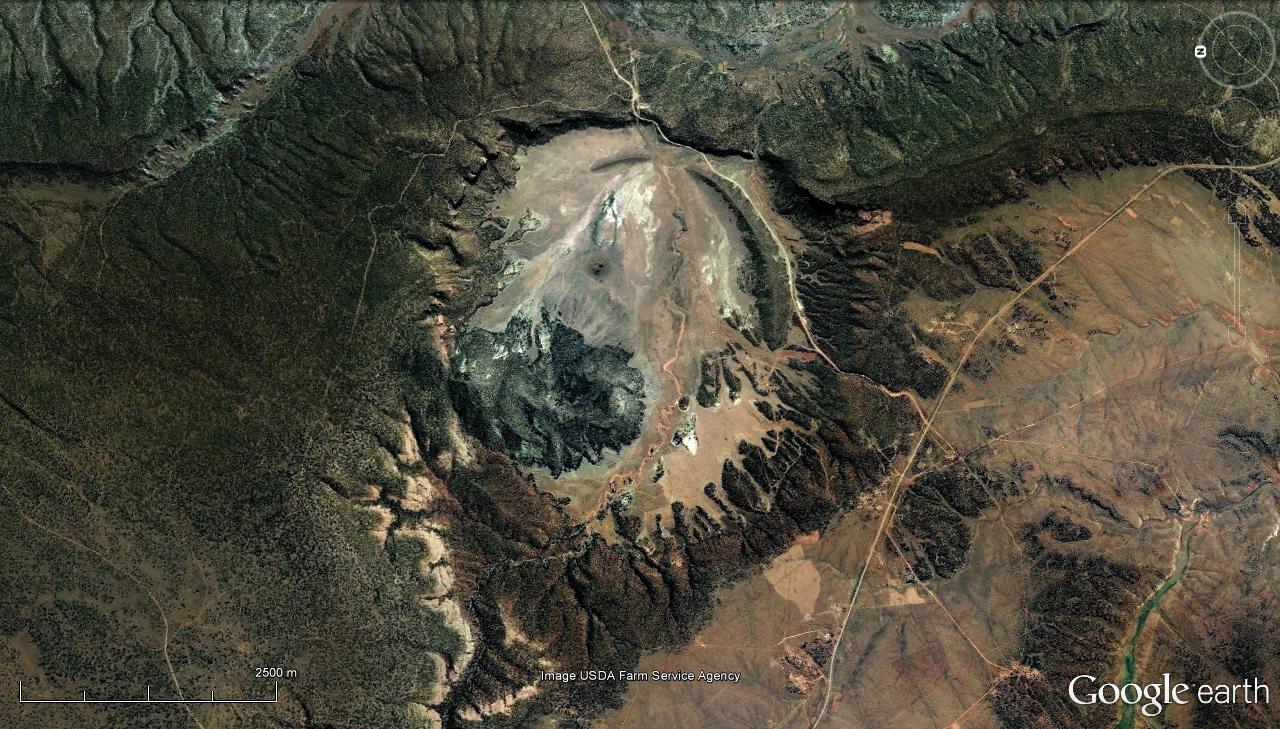
Now its time for WOGE 352.  Once you locate this area it should be relatively easy to find some good information about the geology.  As always, be the first person to post a comment with the coordinates of the location and some explanation of the processes or features that make it geologically interesting and you will  win the privilege of hosting the next challenge.  See Felix Bossert's blog for complete rules and hints. Since the game has been a little slow lately, the Schott rule is not in effect, and I will post a first hint in just a few days if necessary.  Have fun!
Here is the first hint.
Still looking?  Maybe a close-up view will help.
See the little thatched huts?  But it's not quite the same as in Felix's last edition.

Here is another hint:  According to the Global Volcanism Program the closest Holocene volcano is almost 2000 km from this location.

Maybe it will help if I double the view again.

Wednesday, May 9, 2012

WOGE 345 - Revised

After a few rather difficult (for me) challenges, I was relieved to see that WOGE 344 was something I could find easily.  Felix chose to show us the Vistula Spit, a beautiful stretch of shoreline near the southern end of the Baltic Sea.  The most important clue for me was the vegetation: it appeared to be a temperate forest rather than a tropical one, so the number of coastlines I needed to check was greatly reduced.

I had a great location in mind for my next WOGE win, but I have decided to put it on hold.  Instead, I will offer anyone who was busy searching for gracefully curved beaches the chance to continue doing so. As always, be the first person to post a comment with the coordinates of the image and a basic description of the geology, and you win the privilege of hosting the next WOGE. (See complete rules and search hints here.) Since Felix did not mention the Schott rule last time, I will not invoke it here either.  Have fun searching!
I welcome any feedback my fellow WOGE players would like to give on whether this almost identical search is a good idea or not.  If this edition is not solved in a few days I will give a slightly adjusted view so that the game can move on quickly to something else.

It has been a few days, so here is a larger view.

Sunday, April 1, 2012

WOGE 339

I had to go way, way south to find WOGE 338 at Cape Royds in Antarctica. This was a bit confusing at first because the shadows would normally suggest a northern hemisphere location, but the snow has clearly been sculpted by strong, persistent south winds.  After I checked a few areas near Greenland I realized that if you went far enough south and took a picture in the summer the sunlight might also be coming from the south. I went around Antarctica checking the scattered ice-free areas and finally found Cape Royds.

Since I was able to locate a cleverly selected location from the famous Ron Schott himself, it would be ungrateful to put any limits on this edition.  To win, just post a comment giving the coordinates of the Google Earth image and an explanation of what we are looking at (geologically speaking).  A mention of the specific rocks/minerals found here might be nice this time.  Also, extra credit if you can figure out how this location is a first for WOGE.

Sunday, February 12, 2012

WOGE 331

When I saw Felix Bossert's WOGE 330 I noticed immediately that this was an arid region in the Southern Hemisphere.  I then made a very unscientific judgment that the landscape was not "red" enough to fit most parts of Australia or Southern Africa.  I began searching in South America by tracing the rivers in areas that seemed promising.  Eventually I was able to discover the Pozo de las Animas, a dramatic pair of sinkholes in Argentina.

For the next edition of WOGE I will try to keep things simple (but interesting) so that the game will move along quickly.  The Schott rule will be in effect.  The posting time below is in UTC.  As always, find the coordinates of the Google Earth image and tell us something about the geology of the location.  The winner gets to host the next challenge. Have fun!

Here is a larger "historical view" that shows more of the key feature.

This is not another location to search for, just a hint about the geology seen above.

Here is another historical view that might reveal something about the climate at this location.

Also, if the detail were greater you would be able to find more than two dozen small boats in the second image above.  Must be a popular place for day trips.  Maybe a larger view will help.


Sunday, January 1, 2012

WOGE 326

I recognized the landscape in Felix Bossert's WOGE 325 as a tundra right away, but it took me a few days to find the time to search green patches in Canada, Alaska, and finally Siberia.  Then it took a little more time to brush up on tundra geology.

For the next edition I have selected an image that could be very tricky to find, so I would like to try something a little different.  For about the first 34 hours this edition will be unrestricted.  If it has not been solved by then, I will post a second image.  The second image will make a very good opportunity for someone new to win the game, so the Schott rule will apply from that point on.  As always, the first person to identify the location and tell something about the geology gets to choose the next WOGE.  If you have not played before, be sure to check out the rules and tips for new players that Felix graciously provides on his blog.  Here is the picture.  Ready. Set. Go!
As promised, here is the second picture.  This means that the Schott rule is in effect, starting at 3:07 UTC January 3.  Remember that you must include the geology of this location to be declared the winner.  Nothing very technical is needed, just a general description.


Sunday, December 11, 2011

WOGE 323

When I saw the rugged mountains in WOGE 322 I immediately thought that they seemed "Himalayan."  (This probably indicates that I have spent too much time on Google Earth lately.)  I focused on that part of the world, and specifically on areas where reddish images met grayish ones.  I discovered that we were looking at a spectacularly beautiful portion of the Zanskar Shear Zone in Kashmir.  I envy Simon Wellings, who has visited the area in person rather than by computer.

For WOGE 323 I will offer an area that would be considerably easier to visit, if you cared to.  The oddly colored lake in the picture has both a ancient and a modern geologic story to tell.  Neither one is complicated or difficult to find (once you know the name of the lake so you can Google it :-)  However, be sure to read far enough to get the right facts.  One source contains incorrect information that is corrected a little further down the page.

For anyone new to Where on Google Earth, the winner is the first person to post a comment with the coordinates of the location shown and some information about the geology of interest.  More complete rules and hints can be found here.  No restrictions on this edition.  Have fun searching!

It has been a few days so I will provide another view.  The mystery lake is not visible in this image, but it should provide a few clues about where to look for it.


Tuesday, November 22, 2011

WOGE 320

Thanks to Felix Bossert for providing an easy and unrestricted WOGE 319.  I happened to log on at the right moment, and I was able to find Hiti Atoll in the South Pacific easily just by flying aimlessly over some of the areas where coral atolls are common.  Thanks to Péter Luffi also, for graciously waiting just long enough for me to post my comment first :-)

Now, what to post for WOGE 320...  Thanks to Felix again, for your suggestion!  I have seen this joked about, but I don't know if anyone has actually done it.  So here it is -- A single sand dune in the middle of a desert.

I will upload larger views if it is necessary, but I suspect this may be an easy challenge for some players.  As always, the first person to find this location with Google Earth and provide a brief description of the geology wins the privilege of providing the next challenge. I will invoke the Schott Rule this time, just because no one has used it in the last month.  If you don't know what the Schott Rule is, then check out the New Players section at Felix's blog.  Posting time is 3:05 UTC

It has been a few days, so I am providing a more standard view.  This is technically a "historical image", but the part with the sand dune is exactly the same.  When you find the location on Google Earth you might notice that something interesting happened in the ten days after this image was made.
I did not expect that this would be a difficult challenge, but now I suspect that everyone may be looking in the wrong deserts.  I would rather not give an even larger view, since it would make things too easy.  Instead, I give you a close-up view of part of the dune at top center in the second image.  I hope that a careful look at this will give someone the hint they need to find the proper desert.  If you have already spent more than fifteen or twenty minutes searching in a particular country, you are probably on the wrong track.
The second picture above is just for comparison.  It is at the same scale and was taken on the same day of the year but, obviously, in a different part of the world.  I hope it makes the hint more clear.